A customer case study from Foodera Technologies describes how Saudi Arabia’s Al-Jouf moved from opening a French-fry factory to committing to a larger line within a year. The account puts the expansion at 5 to 7.5 tonnes per hour, a useful example of capacity planning that should be kept distinct from measured annual output.
A dated expansion story
De acuerdo con Foodera’s project account, Al-Jouf inaugurated the factory in May 2024 and committed to the expansion within the following twelve months. The supplier describes the equipment and quotes general manager Abdulmohsin Aljarallah on the partnership.
The wording matters: this is the supplier’s retrospective customer story, not an announcement that the original plant first opened in November 2026. Nor does the reported commitment alone establish the current utilisation rate, commissioning outcome of every stage or the quantity sold into a market.
De lunes a viernes. Cancela tu suscripción con un solo clic.
The line is a connected process
The case study identifies washing and peeling, cutting, drying and frying among the installed process functions. That is the useful operating context for the capacity figure. A headline increase at one point needs to be considered together with the surrounding process and the specification of the product leaving it.
For an operator planning a similar project, the comparison should identify the product basis of each capacity claim and the conditions under which it is expected to hold. Raw-potato intake, finished-product output and saleable product over a full shift are not automatically interchangeable measurements.
A larger hourly figure is not an annual forecast
The arithmetic increase from 5 to 7.5 tonnes per hour is 50%. It describes the change in the quoted nominal rate. Annual production also depends on operating time, product mix, stoppages and the material accepted as finished product. Those factors are not replaced by multiplying a headline rate by every hour in the calendar.
The published account does not provide the operating records needed for that calculation. It should therefore be read as evidence of the project’s stated scale and direction, with the supplier clearly identified. Financial returns, market share and industry-wide demand growth require separate evidence.
What the case offers the potato supply chain
For growers and raw-material suppliers, a processing expansion raises questions about delivery timing, acceptable varieties and the consistency expected at intake. The useful next conversation is the actual purchase specification and procurement programme, rather than an assumption that all additional theoretical capacity is immediately available demand.
For processors, the case illustrates why an expansion brief should connect equipment design, raw-material supply and the planned finished product. A clear baseline, an agreed capacity definition and subsequent operating measurements make the comparison assessable. Al-Jouf’s story is a named industrial example; its wider value lies in the questions it helps another project ask, while the results remain attributed to the parties that reported them.
Puntos clave
- Foodera dates the original factory inauguration to May 2024.
- The quoted nominal rate rises from 5 to 7.5 t/h, a 50% increase.
- Supplier-reported capacity should be separated from measured utilisation and annual output.
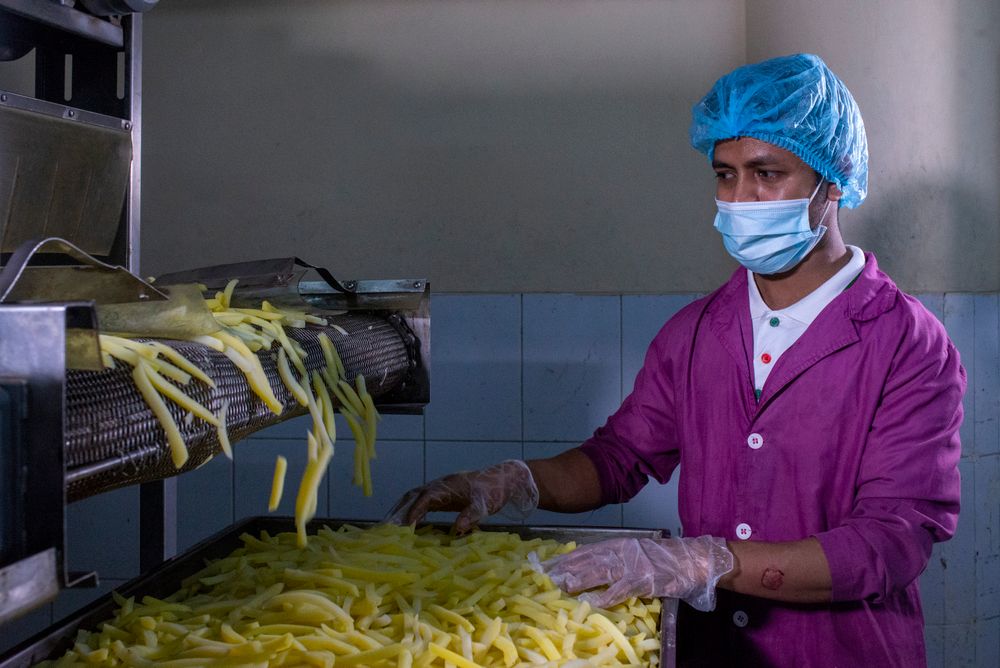
Illustrative French-fry production photograph. Photo: Tanvir Khondokar / Pexels.