El fenómeno de Pavlodar: cómo las patatas están transformando la agricultura en Kazajistán
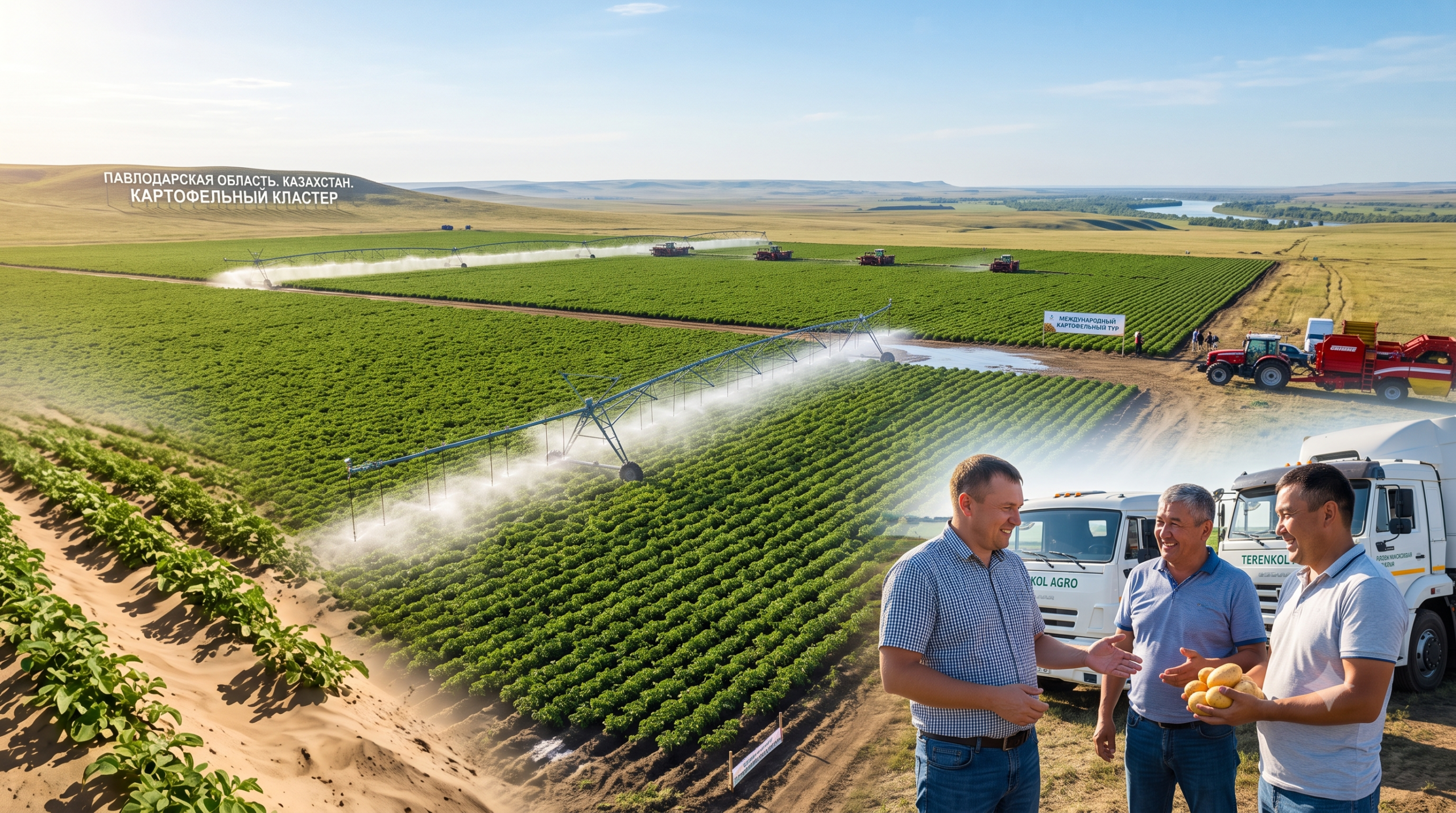
Informe especial del International Potato Tour: región de Pavlodar, Kazajistán
Hoy, la región de Pavlodar es uno de los principales clústeres de cultivo de patata en Kazajistán. Como parte de nuestro International Potato Tour, visitamos los distritos de Zhelezinsky y Terenkolsky para observar de primera mano cómo los agricultores locales cosechan rendimientos récord en suelos arenosos, pese al calor anormal y la escasez de recursos. Proporcionan el “second bread” no solo para su propia región sino también para la capital, mientras exportan sus productos a los países del sur.
Sand and Sun: Perfect Washing and Harsh Dunes


The specifics of potato farming in this region are dictated by nature itself. The local soils are predominantly sandy. On one hand, this is an undeniable advantage during the harvest.
“Si no llueve durante la cosecha, nuestras patatas salen perfectamente limpias, como recién sacadas de la lavadora,” comparte Dmitry Kozinets, director de la finca campesina “Terenkol Agro”, que pasó a la agricultura desde el negocio del transporte en 2017.
However, sand has its dark side—severe wind erosion. Timur Kabdulov, head of the “KAP” peasant farm, who cultivates 550 hectares of potatoes, talks about battling the elements:
“We have terrible wind erosion here. If you make a classic fallow land with soil cultivation, dunes 50 centimeters high grow right at the end of the fields. Therefore, I try not to touch the soil; I use chemicals and sow oats to secure the topsoil.”
El segundo desafío es el clima. El calor anormal (más de 30°C durante un mes) requiere riego continuo. Los agricultores aportan 15‑20 mm de agua, y las máquinas de riego nunca se detienen ni un minuto.
From Grain to Vegetables: Economics and Profit Margins
It is interesting to observe how the profile of the farms is changing. Many managers and agronomists were staunch “grain growers” in the past. What makes them switch to vegetables? The answer is simple: economics.
For large livestock complexes, potatoes become a financial cushion. Nikolay, an agronomist at a young farm with 5,000 heads of cattle, explains this strategy:
“Cultivar forraje en nuestra zona no irrigada (bagara) es muy difícil. Introdujimos parcelas irrigadas, construimos reservorios y perforamos pozos de 850 metros de profundidad. Estos son fondos prestados enormes. Se necesita mucho tiempo para que el forraje crezca y la vaca produzca leche. Pero las patatas y las zanahorias representan efectivo inmediato. Las cultivamos, las vendemos y, en el mismo año, disponemos de capital de trabajo para saldar nuestras deudas.”
The entry barrier to this business is high today. According to Dmitry Kozinets, with the capital he started with 9 years ago (buying an old Soviet DDA sprinkler system), he could only manage about 10 hectares today. Now, farmers use modern frontal and pivot machines, powerful equipment (such as Grimme), and build state-of-the-art vegetable storages with government support (subsidies for storage facilities are about 800,000 tenge per ton, and up to 30% for elite seeds).
El líder indiscutible: variedad Gala
There is a monopoly of one variety in the fields of the Pavlodar region. The vast majority of farms rely on the Gala variety. The reasons are pragmatic: excellent keeping quality, stable yield, and high market demand. Experiments with red varieties show that local clients and buyers from Uzbekistan (the main export destination) prefer yellow potatoes.
Farmers try to purchase seeds of the highest reproduction (elite seeds are even imported from Germany) and propagate them on their farms, providing themselves with excellent quality planting material for several years ahead without losing yield.
Agronomy: The Battle for Tuber Health
El cultivo de patata requiere una atención inmensa. Eldar Usmanov, agrónomo en “Astyk PV” LLP (2,500 hectáreas bajo riego), compara su trabajo con la medicina:
“A potato is like a living creature. It needs a lot of attention; you have to constantly monitor it. The plant is alive, and we are its doctors. We must ensure that it stays healthy.”
And there is plenty to treat. Under intensive irrigation, farmers face a complex of diseases:
- Rhizoctoniosis (mancha negra): Uno de los principales problemas en suelos ligeros, que provoca grietas en los tubérculos. La lucha se lleva a cabo aplicando fungicidas modernos (azoxystrobin, fludioxonil) directamente durante la siembra.
- Alternariosis (early blight): Appears during heat stress, starting in late June.
- Late Blight (Phytophthora): Although not an annual disaster, it keeps farmers on high alert. The number of preventive treatments in some farms has grown from 2 to 8-9 per season.
- Plagas: Los nematodos y los gusanos de alambre también requieren ajustes en la rotación de cultivos y el uso de insecticidas (p. ej., fipronil).
El esquema de nutrición también es intensivo. Se aplican dosis impresionantes al suelo antes de la siembra y del aporcar: 500 kg de fosfato diamónico (DAP), cloruro y sulfato de potasio, y nitrato de potasio.
Infrastructural Barriers: Water and Electricity
The main obstacle to the development of irrigated agriculture in the region today is not a lack of land or equipment, but an electricity shortage.
According to Eldar Usmanov, when the active irrigation season begins and neighboring large farms simultaneously turn on dozens of pumping stations, there is a catastrophic lack of voltage in the grid.
The second problem is access to water. Farms located far from the Irtysh River (up to 150 km) have to drill ultra-deep wells (up to 850 m) with low yields (only 20 l/s) and build huge storage ponds, which requires massive investments.
The Human Factor
A pesar del calor, las tormentas de arena, las enfermedades de los cultivos y los cortes de energía, las personas que trabajan aquí están verdaderamente apasionadas por lo que hacen. La mayoría de las fincas son familiares, donde la experiencia se transmite de padres a hijos, y las responsabilidades se distribuyen claramente entre hermanos y hermanas (como, por ejemplo, en la finca campesina “Kundyz”, que ha pasado de 40 hectáreas en 1993 a 15,000 hectáreas hoy).
When asked what gives them strength when they feel like giving up, the farmers unanimously answer: the support of their families, love for their work, and, of course, the magic of the result.
“La parte más agradable para mí es el proceso de cosecha,” resume el agrónomo Nikolay. “Cuando ves lo que has cultivado durante la temporada y lo cosechas, sientes una alegría en el corazón al ver que todo ha funcionado y transcurre sin problemas.”